


Occupancy is down. Phones are quiet. Marketing feels invisible… yet you’re spending thousands.
Sound familiar?
Most senior living communities think they’re advertising. But generic campaigns, vague messaging, and scattered budgets don’t move families to act, especially when they’re overwhelmed with options and racing against time.
The truth: You don’t need to advertise more. You need to advertise smarter.
In this guide, we’ll break down the exact strategies that are filling units from real examples of high-converting Google and Facebook ads, to how facilities are using local SEO and reputation campaigns to show up where it matters.
Whether you’re a marketing director, sales lead, or executive decision-maker, you’ll walk away with a clear plan to:
- Cut wasted ad spend
- Boost occupancy with targeted messaging
- And finally ,connect with the families actively searching for care
Let’s get into it.
What Is Senior Living Advertising?
Senior living advertising is how you put your community in front of the families who are actively searching for care. It’s not just marketing it’s targeted, paid outreach designed to generate leads, tours, and move-ins.

But here’s the nuance: In this industry, you’re not selling products. You’re helping families make one of the hardest decisions of their lives. That means trust, timing, and local visibility matter just as much as the ad itself.
While marketing focuses on long-term nurturing, advertising ensures your community appears the moment someone searches “assisted living near me.”
Related: Learn how to build trust through reputation ads that support your paid campaigns.
Senior Living Marketing vs Advertising: What’s the Difference?
| Marketing | Advertising | |
| Focus | Long-term strategy, content, brand-building | Immediate visibility, lead generation |
| Channels | SEO for senior living facilities, social media, email | Paid advertising campaigns, direct mail, local display |
| Cost Model | Mostly time and internal resources | Pay-per-click (PPC), pay-per-impression (CPM) |
| Speed | Slower, compounding over time | Fast can generate leads within days |
| Goal | Build authority, educate, nurture | Get inquiries, book tours, drive move-ins |
Pro Tip: Integrate your ad efforts with CRM & marketing automation tools to track every lead and optimize spend.
Think of advertising as the fuel that accelerates your marketing engine. If done well, it brings in high-intent prospects who are ready to make a move fast.
Why Smart Senior Living Advertising Drives Occupancy?
Every empty unit is lost revenue. But it’s not just about money. It’s about missed connections with families who would have chosen your community if only they’d found you first.
That’s where great advertising comes in.

It drives awareness, builds trust fast, and brings the right people to your doorstep. Especially in a market where:
- Competition is fierce (new communities open every year).
- Families are scattered across states, relying on Google.
- Decision timelines are shrinking ,people search and call in the same day.
Communities that don’t advertise strategically tend to fall into one of two traps:
- They rely on outdated tactics (like generic print ads or untracked campaigns).
- Or they spend heavily online… but without targeting or measurement.
Neither works.
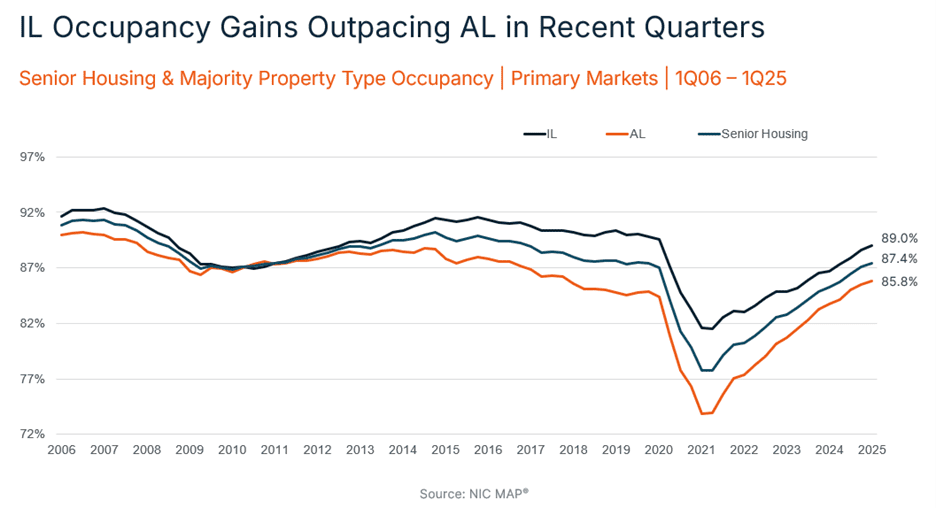
A recent NIC MAP report shows that senior housing occupancy in the 31 primary U.S. markets hit 87.4% in Q1 2025, with independent living at about 89.0% and assisted living at 85.8% a sign demand is strong and the playing field is tightening.
If your marketing still feels like a guessing game, it’s time to fix that.
We’re about to show you how.
The Best Channels for Senior Living Advertising (And How We Actually Use Them)
When you run ads for a fashion brand, you’re selling want. When you run ads for a senior living community, you’re selling trust, urgency, and peace of mind all at once.

That’s why ad performance in this space depends on how well you match the message and medium to the moment the family is in. Over the last few years managing senior living campaigns, we’ve tested nearly every channel. And here’s what we’d recommend if you’re trying to fill units not just burn budget.
Google Ads: Where Urgency Lives
Families don’t browse Google casually when they’re searching for “memory care near me.”
They’re in a decision window. Maybe something happened with Mom last night. Maybe they just had “the talk” with Dad. Either way, they want answers now and Google is the first place they go.
For communities, this is gold but only if the ads are tightly targeted.
We worked with a 50-bed assisted living facility that had been spending $2,500/month on Google Ads. But they were using broad keywords like “senior housing” and “retirement options” and getting job applicants and people looking for 55+ condos.
We cut that waste fast. Rebuilt the campaign around search terms with clear intent:
- “assisted living near [CITY]”
- “dementia care facility”
- “help moving aging parent into care”
Within 45 days, they were getting calls daily. Cost per inquiry dropped by 60%, and tour bookings doubled no increase in spend.
What made the difference?
We stopped casting a wide net. We focused on urgency, location, and the exact words families use when they’re ready to act.
Bonus tip: Add call tracking and set your ads to only show during business hours. Families who click at 9 PM often call the next morning make sure you’re ready to capture them.
Facebook & Instagram: Where Emotional Decisions Begin
While Google catches families who already know what they need, Facebook captures those who are just starting the journey usually the adult daughter.
She’s not typing “assisted living” yet. She’s scrolling after work, feeling overwhelmed, wondering how she’s going to keep caring for both her kids and her parents.
That’s where visual storytelling wins.

One of our most effective campaigns was a 45-second video showing a resident laughing during art therapy. No script, no sales pitch, just real footage, with one line of text: “What if Mom felt at home again?”
That ad brought in 46 leads in 3 weeks. Half of them hadn’t even heard of the community before seeing it. And several told the staff, “Your video made me tear up I had to call.”
If you’re only using static images or boosting posts, you’re missing out. The best social campaigns in this space are emotionally honest, locally targeted, and built around moments, not marketing buzzwords.
Here’s what we’ve learned works best:
- Target by zip code, age 40–65, parent status, and interests like caregiving or Alzheimer’s.
- Run retargeting for website visitors who didn’t convert the first time.
- Follow up fast Facebook leads go cold within hours if no one calls.
Skip the agency fluff. Families respond to real. Your caregivers. Your residents. Your story.
Google Business Profile Ads: Underrated, Overperforming
Most communities don’t realize they can pay to have their Google Business Profile show up above competitors in the Maps pack. But you can and it’s often the cheapest way to generate phone calls.
We helped a mid-size memory care provider in Michigan who had a strong reputation (60+ reviews, 4.7 stars) but wasn’t showing up consistently. A few tweaks to their GBP profile + $300/month in local ads moved them into the top 3 map results.
Phone calls jumped immediately and they closed two move-ins within the first month from Google Maps alone.

Why does this work so well?
Because when someone types “assisted living near me,” they’re not reading blog posts. They’re calling whoever’s listed first, looks credible, and picks up the phone.
The magic here is pairing GBP ads with:
- High review volume and recent responses
- Service descriptions (memory care, respite stays, etc.)
- Location-specific photos (real, not stock)
Pro tip: Set up a call tracking number just for your GBP listing so you know exactly how many calls are coming from it.
Print & Events: Still Worthwhile (If You Do It Right)
We’ll be honest: 80% of ad spend we recommend goes to digital. But that other 20%? It can still make a real difference especially in local markets where people trust what they see in print or at church.
For one of our clients in the Midwest, we combined a small print ad campaign in senior magazines with Facebook retargeting and a Google branded search campaign.
The print ad said: “We saved a seat for you this Sunday come see what it’s like to live here.”
We listed a date for an open-house brunch and backed it with:
- Facebook event ads to locals aged 45+
- Google Ads triggered by the name of the event
- Custom QR code on flyers to book a tour

Only 4 families RSVP’d from print directly. But 17 showed up and 11 of them had seen the print, then Googled the name and clicked a paid ad.
That’s how modern offline advertising works: It drives online behavior. But only if you connect the dots.
Quick Channel Breakdown (For the Busy Marketer)
| Platform | Best At | Use It If… | Avoid If… |
| Google Ads | Capturing urgent intent | You need leads now and have clear services | You’re running broad, untargeted keywords |
| Facebook/Instagram | Storytelling + retargeting | You can show the human side of your community | You’re using stock photos + generic text |
| Google Maps / GBP | Local call generation | Your reviews are strong and your team picks up | You don’t have call tracking or reviews |
| Print & Events | Local awareness + brand lift | You have strong community ties and open events | You’re not pairing it with digital follow-up |
4 Winning Senior Living Ad Campaigns (Real Strategies You Can Steal)
Want campaigns that actually move the occupancy needle?
These real-world examples show exactly how smart operators are using paid ads, messaging, and targeting to get leads that convertand how you can apply the same playbook.
1. Creative Website Marketing: Turning PPC Into a Resident-Generating Machine
A senior living corporation partnered with Creative Website Marketing to replace expensive aggregator leads with high-intent prospects. They restructured their entire PPC approach:
- Separate Google Ads campaigns per community
- Only high-converting keywords like “assisted living near me”
- Offline conversion uploads (tours and move-ins) synced to Google Ads
The result?
- 65% increase in lead quality
- 4.1x return on ad spend
- Roughly 15 high-quality leads per community, per month
How to apply this strategy:
- Run geo-specific campaigns with narrow radius targeting
- Set up Google conversion tracking for real-world outcomes (not just form fills)
- Use cost-per-acquisition bidding based on actual resident lifetime value
2. Mentum: Rewriting the Narrative Around “Nursing Homes”
Glenview Terrace Rehab was struggling with a brand problem. The term “nursing home” was turning people away.
Mentum, a Chicago-based creative agency, helped them pivot the message. Their campaign reframed the story, speaking directly to adult children rather than the seniors themselves.
The voice of the campaign came “from the parent” to the caregiver. It ditched clinical language in favor of human connection.
The result?
- Occupancy stabilized at 83%
- Community perception shifted
- The brand began resonating with the true decision-makers
How to apply this strategy:
- Craft messaging that acknowledges caregiver guilt and urgency
- Avoid cold, clinical descriptions on family, safety, and peace of mind
- Run messaging tests on both digital and print channels to validate emotional pull
3. Orange142: Delivering 116 Qualified Leads in 90 Days
A multi-location assisted living chain needed to generate 75 leads in 3 months.
They hired Orange142, a data-driven marketing agency, to manage their digital campaigns.
Here’s how they did it:
- Built lookalike audiences based on family member data from CRM
- Used behavioral targeting (women 40–60, caregiver-related interests)
- Ran a tight remarketing funnel across platforms
The results were impressive:
- 116 qualified leads in 90 days
- Cost per lead: $25.86
- 3X return on ad spend
How to apply this strategy:
- Pull resident family data and create lookalike audiences on Meta and Google
- Layer contextual targeting with search intent (“memory care + [city]”)
- Use remarketing to re-engage visitors who didn’t convert the first time
4. Asymmetric: Scaling Local Campaigns to Fill BedsFast
Asymmetric, a senior-living-specialized marketing firm, worked with operators across Wisconsin to turn underperforming properties around.
Some standout results:
- Milestone Senior Living (9 locations): Occupancy increased from 82% to 95.5% in just 9 months, with a 20x return on ad spend
- Copperstone Assisted Living: Grew from 50% to 75% occupancy in under 5 months using Facebook and Google Ads
- A third client saw $1,636 in spend generate 11 web leads and 15 phone callsroughly $63 per lead
Even staff hiring was streamlined:
- Facebook job ads for a client generated 157 applicants at just $17.59 per lead
How to apply this strategy:
- Geo-target ads within a 5–10 mile radius to avoid wasting budget
- Use ad creative that focuses on what matters to local families: safety, independence, and quality of care
- Implement call tracking and unique forms for each campaign to track true ROI
5 Traits All These Campaigns Shared
Despite different agencies and tactics, the best campaigns had the same DNA:
- They targeted the real decision-maker: adult children, not seniors
- They spoke with empathy, not formality: avoiding medical jargon and focusing on emotional triggers
- They stayed local: no wide-radius ad wastage
- They tracked conversions, not just clicks: calls, tours, move-ins were all measured
- They optimized fast: based on real performance, not assumptions
These aren’t one-off wins. They’re repeatable frameworks built around trust, data, and relevance.
If you’re still running generic ad campaigns and wondering why leads aren’t turning into tours, now you know where to look.
Want to build a campaign like this for your community? Book a free strategy call.
Best Practices for Senior Living Advertising Campaigns (That Actually Drive Move-Ins)
It’s not enough to run ads. Plenty of communities do that and still end up wondering why no one’s calling.
The truth is, most assisted living advertising fails not because of budget… but because of how the campaign was set up in the first place.
Below, we’ll show you what separates the campaigns that fill units from the ones that burn cash. These are the practices we use across all our high-performing accounts based on real wins (and a few hard-learned lessons).
Start with Who’s Really Making the Decision
This is the most common mistake we see: Communities create ad campaigns as if they’re speaking to seniors but most seniors aren’t the ones clicking.
You’re advertising to adult children.
She’s 42. She’s managing her own family. She’s exhausted, emotional, and doesn’t have time to dig through generic slogans like “Care That Feels Like Home.”
You’ve got about 3 seconds to make her feel seen.
What works:
- Headlines like “Worried About Mom Living Alone?” or “We Help Families Navigate Tough Decisions.”
- Copy that acknowledges guilt, stress, and uncertainty then offers clarity and relief.
- Visuals that show real residents engaged, not just empty hallways or staged lunch tables.
Client example: We reworked ad copy for a memory care campaign from: “Specialized Alzheimer’s Care in a Warm, Friendly Environment”
→ to: “Dad’s forgetting more lately. We help families find answers and peace of mind.”
Same budget. Same geo-targeting. CPA dropped 40% in two weeks.
Geo-Target Tighter Than You Think You Need To
There’s no point in paying for clicks from 40 miles away.
If your average move-in radius is 10–15 miles, target your ads even tighter. Especially on Facebook, where relevance makes or breaks results.
For one campaign, we narrowed Facebook ads from a 25-mile radius down to 8 miles and lead quality jumped immediately. Tours booked were higher, follow-up was easier, and the sales team wasn’t wasting time with long-distance maybes.
Here’s our general rule of thumb:
- Urban areas: 5–10 mile radius
- Suburban: 10–15 miles max
- Rural: Up to 25 miles only if you’re the only facility around
Also: don’t just target by location. Layer on:
- Age (40–65)
- Parent status
- Interests like caregiving, eldercare, Alzheimer’s
- Income brackets (if applicable)
If you can’t explain who your ad is talking to in one sentence, don’t run it.
Use Empathy, Not Jargon, in Your Messaging
It’s tempting to write ads like you’re building a brochure.
But no one scrolls through Facebook thinking, “I’d love to see some 5-star amenities and a continuum of care narrative today.”
What grabs attention is emotion.
Think about what the decision feels like not what your community offers.
You’re not selling “services.” You’re offering relief. You’re offering permission to stop doing this alone.
What works:
- First-person headlines (“We couldn’t do it by ourselves anymore”)
- Testimonials with real quotes (even if they’re paraphrased)
- Copy that mirrors the decision-maker’s actual thoughts
The best ads feel like they were written by a family member not a marketer.
Budget: Start Smart, Then Scale with Proof
We get asked this a lot:
“How much should we spend on advertising each month?”
There’s no perfect number but here’s how we usually frame it:
- Start with at least $1,500–$2,000/month across channels: That usually allows room for one or two serious platforms (Google + Facebook) plus a few retargeting campaigns.
- Expect to test for 30–45 days: The first few weeks are about finding the right message + audience combo. Don’t pull the plug too fast.
- Once you find a winning combo scale confidently: We’ve seen facilities double their spend on a top-performing ad set and maintain the same cost-per-tour.
What to avoid:
- Spreading $300 across 5 platforms you’ll learn nothing.
- Keeping campaigns on autopilot for months without checking performance.
Instead, treat advertising like a system. Not a slot machine.
Launch With a Checklist, Not a Hunch
Every time we’ve had a campaign flop, it was because someone skipped a basic step.
Here’s the checklist we now run before every single launch. Steal it:
Senior Living Ad Campaign Setup Checklist:
- Is the target audience defined (age, location, family role)?
- Is the ad speaking to the decision-maker, not the resident?
- Do we have at least one real photo or video?
- Is the headline emotionally resonant not just informational?
- Are we tracking calls, forms, and tours with clear attribution?
- Is there a dedicated landing page (not the homepage)?
- Is there a clear CTA (e.g., “Schedule a Tour”) above the fold?
- Is follow-up set up within 1 hour of form submission?
One of our clients added that last line about 1-hour follow-up after losing two warm leads who never got a callback. Now they get notified in Slack the moment a new form is submitted. Zero delay.
If you’re checking all these boxes, you’re already ahead of 90% of senior living marketers out there.
Next up, I’ll cover: Common Mistakes to Avoid in Assisted Living Advertising including campaign killers we’ve seen firsthand.
5 Common Mistakes to Avoid in Assisted Living Advertising
Most of the time, when ads aren’t working, it’s not the platform’s fault. It’s the setup.
We’ve audited dozens of senior living ad accounts Google, Facebook, even local print buys and the patterns are painfully familiar. Same problems, different zip codes.
If your campaigns aren’t converting, there’s a good chance you’re making one (or more) of these mistakes.
Let’s break them down.
1. Talking to the Wrong Person
Let’s say this clearly: You’re not selling to seniors. You’re selling to their adult children.
This single misstep writing ad copy that assumes a senior is clicking ruins more campaigns than any other.
We once reviewed Facebook ads for a large regional operator. The headlines said things like: “Come enjoy chef-prepared meals and meet new friends.”
But 90% of their leads came from daughters aged 40–60. We rewrote the campaign to focus on her pain points: “Worried about Mom living alone? See how we help families make safe transitions.”
Same targeting. Same landing page. CTR doubled, and cost per lead dropped by 37%.
Quick fix: Read your ad out loud. If it sounds like a cruise ad or a lifestyle pitch, you’re probably off-target.
2. Running “Feel-Good” Ads With No CTA
A beautifully shot video showing residents laughing in the garden doesn’t help you if there’s no clear next step.
We’ve seen high-budget ads that end with nothing but a logo and a slogan. No phone number. No tour button. No form.
These ads feel good but they don’t convert.
Instead:
- Use strong calls-to-action like “Schedule a Tour,” “Call for Availability,” or “Speak With Our Care Team.”
- Put the CTA in the first 5 seconds of your video or above the fold in static ads.
- Repeat it at least once. People scroll fast don’t assume they’ll remember.
CTA doesn’t mean pushy. It means helpful.
3. Ignoring Mobile Optimization
This one’s brutal.
Most of your traffic, especially from Facebook and Google, is mobile. If your landing page loads slowly, has tiny buttons, or buries the form three scrolls down, you’ve already lost them.
We helped a client whose ads were solid, but the bounce rate on mobile was 78%. Turned out their site took 6.2 seconds to load on 4 G.
We:
- Compressed images
- Added click-to-call buttons at the top
- Moved the tour scheduler form above the fold
Their bounce rate dropped to 33%, and leads tripled no change to the ad budget. Check your own landing page on a real phone. If it frustrates you, it’s killing conversions.
4. Measuring the Wrong Metrics
Clicks don’t matter. Leads matter. Tours matter. Move-ins matter.
If your agency or in-house team is showing you vanity metrics like “impressions,” “CTR,” or “reach,” ask them to stop.
Here’s what actually moves the needle:
- Cost per qualified lead (form or call)
- Cost per booked tour
- Cost per move-in
- Time from click to call
Without this, you’re just guessing. And we’ve seen communities waste thousands because no one was tracking what happens after the click.
You wouldn’t run your census reports on “hallway foot traffic.” Don’t run ad campaigns that way either.
5. Forgetting the Follow-Up
You can have the perfect ad, the perfect landing page, and the perfect targeting and still lose if no one calls the lead back.
We once installed call tracking for a client and found 40% of their inbound calls were never answered or returned.
Here’s the hard truth: Most families won’t leave a voicemail. And if you wait more than an hour to follow up with a form lead, the chances of reaching them drop by 80%.
What we recommend:
- Use call tracking software (like CallRail) to log every call
- Route form submissions to a shared Slack or email alert
- Assign clear ownership for follow-up with response-time SLAs
Treat every lead like a life decision because that’s what it is for them.
Final Thought
Every dollar you spend on advertising is a bet on trust, timing, and clarity. When those align, move-ins follow.
When they don’t, you’re just shouting into the void.
Avoid these mistakes, and you won’t just run ads, you’ll run campaigns that actually fill rooms.
How to Measure Success in Senior Living Advertising the Right Way?
Running ads is easy. Proving they work is the hard part.
We’ve seen communities spend $5,000+ per month and say, “We think it’s working…”
Meanwhile, no one’s sure how many leads turned into tours or which platform brought in that last move-in.
If that’s where you are, you’re not alone. But that’s also where growth stalls.
In this section, we’ll show you exactly how to measure advertising success in a way that helps you optimize spend, justify budgets, and drive real census growth not just clicks.
What to Track (And What to Ignore)
Let’s start with this:
The goal of your ads is not traffic. It’s conversations with families who might move in.
That means your success metrics need to reflect the real sales process:
| Metric | Why It Matters |
| Cost Per Lead (CPL) | Tells you how efficient your campaign is at generating inquiries |
| Cost Per Tour Booked | Connects your ad spend to real sales activity |
| Cost Per Move-In | The bottom-line number that shows ROI |
| Lead-to-Tour Rate | Shows how effective your follow-up process is |
| Tour-to-Move-In Rate | Reflects quality of the lead + sales experience |
| Time to First Response | Critical for form fills & Facebook leads |
We ask all our senior living clients the same thing during onboarding: “If we send you 100 leads, how many do you need to close one move-in?”
If you don’t know, you’re flying blind.
Real Benchmarks from Real Campaigns
There’s no one-size-fits-all number. But here’s a breakdown of the ranges we typically see for successful campaigns across our clients:
| KPI | Strong Campaign Range |
| Cost per lead | $25 – $75 |
| Cost per booked tour | $80 – $200 |
| Cost per move-in | $350 – $900 |
| Lead-to-tour conversion | 20% – 40% |
| Tour-to-move-in | 20% – 30% |
| Response time to lead | < 1 hour (ideal is < 15 min) |
Keep in mind: assisted living leads are more urgent than independent living. Response speed matters more.
How to Attribute Leads Properly
Here’s where most campaigns fall apart: You’re running Google Ads, Facebook Ads, SEO, GBP optimization but you don’t know which one is actually driving move-ins.
Fix this with three things:
1. Call Tracking
Set up trackable phone numbers for:
- Google Ads
- Facebook Ads
- GBP / Maps
- Website organic traffic
Use tools like CallRail or WhatConverts to log calls, record them, and tie them back to the source.
One of our clients found 60% of their move-ins were coming from Google Business Profile calls not the $3,000/mo SEO retainer they thought was driving results.
2. Form Attribution
Use hidden UTM fields on your lead forms that capture:
- Source (Google, Facebook, etc.)
- Campaign name
- Keyword (if applicable)
Push this data into your CRM or at minimum into a shared spreadsheet for the sales team.
3. Ask Every Lead “How Did You Hear About Us?”
Still the simplest and often most accurate tool especially when families search on one platform, but convert on another.
Combine this with digital attribution to see cross-channel influence.
(Example: Saw us on Facebook → Googled us later → called from GBP.)
What About ROI?
If your average lifetime value (LTV) of a resident is $36,000 (12 months at $3,000/month), even a $900 cost per move-in is a great return.
We regularly help clients hit 3X–5X ROI on their paid campaigns. But to get there, you have to track what matters and trim what doesn’t.
If you can’t see ROI within 60 days of ad spend pause, audit, and fix your tracking.
Keytawkays:
- You’re not running ads to feel busy. You’re running them to increase occupancy, grow revenue, and help more families.
- Measure what matters. Attribute every lead. And know with confidence what’s working and what’s not.
How to Get Started With Senior Living Advertising (or Reboot It the Right Way)
If you’re new to advertising or your past campaigns haven’t worked don’t overthink it.
Most successful strategies we’ve seen didn’t start with perfect creative or massive budgets.
They started with clarity.
Here’s how we typically guide our senior living clients when they want to launch or rebuild their advertising without wasting another dollar.
1. Audit What You’re Already Doing
Before launching anything new, figure out what’s already in motion and whether it’s working.
Ask your team:
- What’s our current ad budget? How is it split (Google, Facebook, print)?
- Do we know our cost per lead / tour / move-in?
- Are we using tracking numbers or just guessing attribution?
We’ve seen communities spend $3K/month for years without ever reviewing lead quality. You can’t fix what you’re not measuring.
2. Choose Your Core Channels (Start Small)
You don’t need to be everywhere.
Start with the two that consistently deliver:
- Google Ads to capture high-intent searchers.
- Facebook Ads to build trust and connect emotionally with families.
If your budget is under $2,000/month, split it between those two and avoid adding more until you’ve seen performance.
Once you see what converts, expand. That’s how you scale with confidence.
3. Build One Landing Page Per Campaign
Don’t send ad traffic to your homepage.
Create a focused landing page with:
- A clear headline that speaks to the decision-maker (not the resident)
- A real photo or video from your community
- 1 CTA: Schedule a tour or request a callback
- Call tracking and UTM tagging set up from day one
We build these in 1–2 days for clients. Sometimes the fix is that simple not the ad, just the destination.
If you don’t have bandwidth, we offer a done-for-you campaign setup that includes page creation, tracking, and launch.
4. Set a 30-Day Test Window (But Follow Up Daily)
No ad campaign is magic on Day 1.
Give it 30 days to learn. But treat every lead from Day 1 like gold.
- Call within 30–60 minutes (ideally faster)
- Personalize your follow-up
- Track what’s working and where leads fall off
You’ll often find the ad’s doing its job the follow-up isn’t.
5. Review & Optimize Like Clockwork
Once you hit Day 30, dig in:
- Where are leads really coming from?
- Which campaigns drove booked tours?
- Can you scale that channel? Or refine targeting?
Use that review to cut what’s not working and double down on what is.
This is where most of our retainer clients see their growth curve kick in after 45–60 days of data-driven adjustments.
Want Help Building Your Next Campaign?
You don’t need to go it alone especially when every empty unit hurts revenue.
We’ve helped dozens of senior living communities fix broken ad funnels, reduce cost per move-in, and scale occupancy using data-backed campaigns.
Book a free strategy call to walk through your current setup and see what’s working, what’s not, and what it would take to fill more rooms.
Final Thoughts: Advertising That Fills More Than Just Your Funnel
Senior living advertising isn’t about clicks, impressions, or pretty dashboards.
It’s about trust.
It’s about reaching the right family, at the right time, with the right messages. They can make one of the most emotional decisions of their lives.
The communities that win occupancy today aren’t spending more. They’re spending smarter. They understand that great campaigns don’t just showcase rooms or amenities. They speak to the fears, hopes, and urgency behind every inquiry.
If you’re ready to stop wasting budget on ads that don’t convert and finally build a system that brings in qualified leads month after month, we can help.
Let’s map out a custom advertising strategy tailored to your community, your market, and your move-in goals. Book a free strategy call now. It’s time your advertising actually worked. Let’s make that happen.
